NYU Graduates Booed Their Own Professor Jonathan Haidt for Writing a Book That Criticized Wokeness

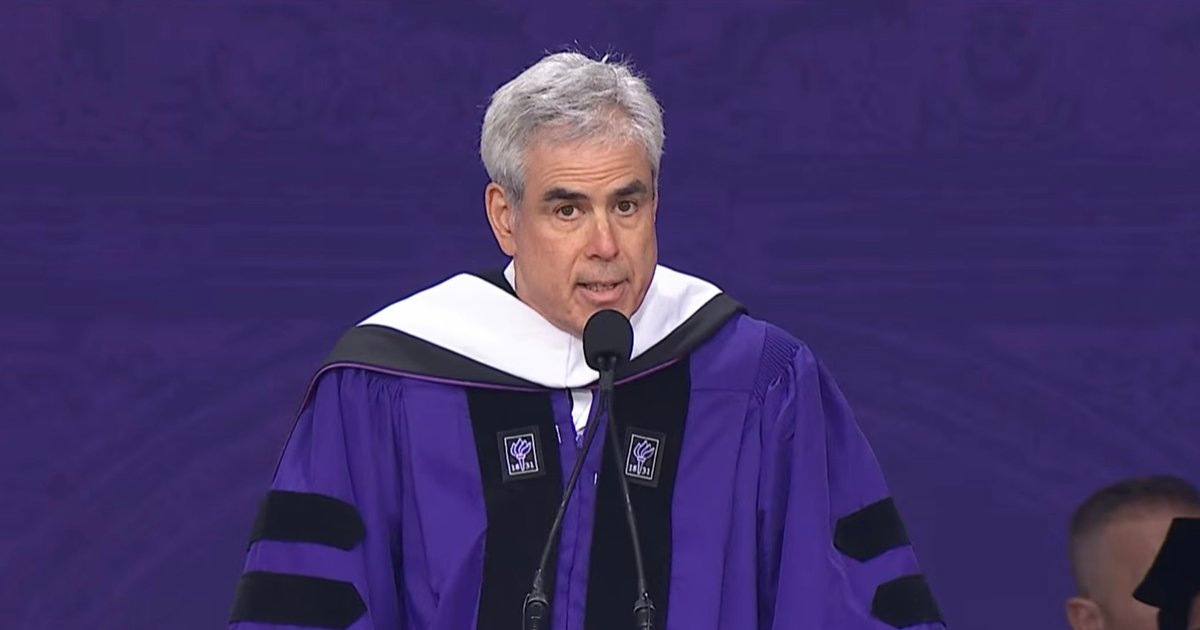
College students can be a rabid bunch, and NYU’s graduating class proved it by booing one of their own professors at Yankee Stadium.
His follow-up to “The Coddling of the American Mind,” called “The Anxious Generation,” has spent over a year on international bestseller lists and is the reason phone-free school policies are now being written into state law.
The protest came from the 4-member Executive Committee of NYU’s Student Government Assembly, not the full student body. Their May 5 statement accused Haidt of “homophobic remarks in a class,” “public misconceptions about transgender identity,” and “disturbing rhetoric around antiracism, social justice, and diversity, equity and inclusion.”
The “homophobic remarks” trace to a 2014 lecture in Haidt’s Professional Responsibility course at Stern, where he was teaching moral psychology using taboo examples to illustrate the “sanctity/degradation” moral foundation, including evolving views on gay marriage. Haidt has been a longtime public supporter of gay rights.
The committee also asked whether choosing Haidt was “yet another effort to push the IRL narrative.” NYU IRL is the university’s own 2026 initiative establishing device-free spaces on campus to reduce phone addiction and encourage face-to-face interaction. It was built on Haidt’s research.
Haidt received an honorary Doctor of Humane Letters and delivered his address at Yankee Stadium on May 14. The speech, titled “Pay Attention,” was warm and non-political. “If there’s just one thing from my address that you remember tomorrow, next week, and 20 years from now, make it this: Treasure your attention,” he told graduates. “What you pay attention to shapes what you care about. And what you care about shapes who you become.”
He also took a shot at Big Tech: “Some of the biggest corporations in human history, they’re not trying to earn your attention. They’re not trying to deserve your attention. They’re trying to take it from you.” And he directly addressed the fragility charge: “Humans, and especially young people, are not fragile. They are antifragile. Antifragile things grow stronger, so we need to expose them to challenges, diligently.”
The Atlantic published the full text the next day so readers could judge the “disturbing rhetoric” for themselves. Greg Lukianoff published a point-by-point rebuttal showing how the petition misrepresents both the book and the speech.
Psychologists at UCLA, Harvard, and Ohio State have found that believing words can harm is associated with worse mental health outcomes, including more anxiety and depression, less resilience, and worse emotion regulation. According to FIRE, Gen Z is roughly 10 times more accepting of using violence to prevent speech than Baby Boomers, and more than 25 times more than the Silent Generation. As of May 7, campus deplatforming attempts had surpassed 100 for the year. In the first quarter of 2026, 65 of 70 attempts succeeded.
In 1990, Wellesley students protested Barbara Bush as their commencement speaker for not being a “career woman.” Older feminists pushed back. Pat Schroeder defended her. Jean Baker Miller called the objections “simplistic.” Bush spoke. Her address is now on NPR’s list of the best commencement speeches of all time.