23 States Are Suing to Block a Trump Executive Order That Would Bar the USPS from Sending Mail-In Ballots to Voters Not on a State-Submitted List

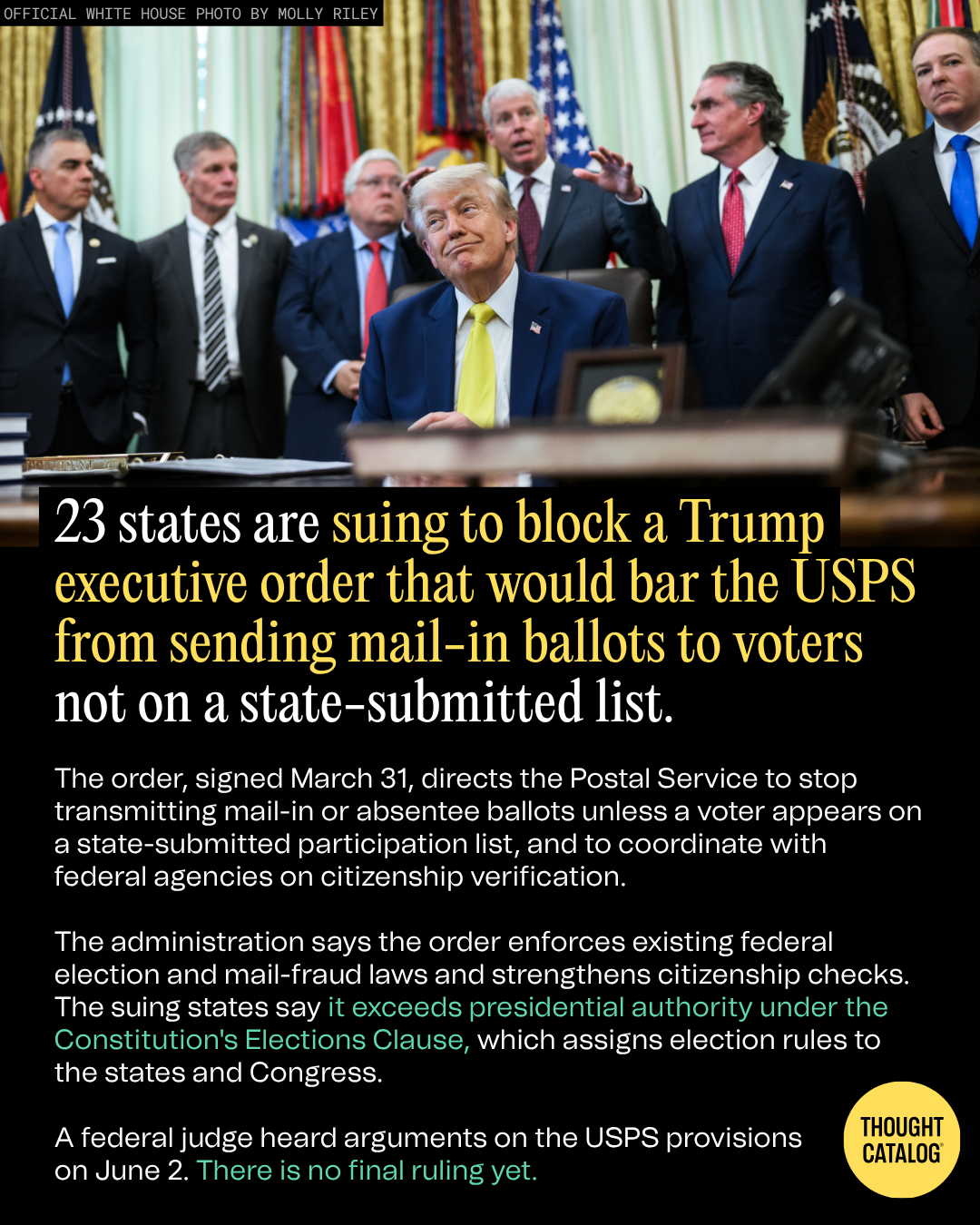
The order at the center of the case is titled “Ensuring Citizenship Verification and Integrity in Federal Elections.” President Trump signed it on March 31, 2026. It directs the Postmaster General to begin rulemaking to set uniform federal standards for how mail-in and absentee ballots move through the U.S. Postal Service.
The provision drawing the most legal attention says the Postal Service shall not transmit mail-in or absentee ballots from individuals unless those individuals are enrolled on a state-specific “mail-in and absentee participation list.” Under the order, states that intend to allow USPS-transmitted mail ballots would notify the Postal Service at least 90 days before a federal election. The order also calls for ballot envelopes with unique identifiers, coordination with the Department of Homeland Security and the Social Security Administration on “State Citizenship Lists” of confirmed citizens, and directs the Justice Department to prioritize investigating ballots issued to ineligible voters. The order does not outright ban mail-in voting. The Postal Service issued proposed rules to carry it out around May 29.
The administration’s stated rationale is to verify citizenship, prevent non-citizens from voting by mail, secure ballot procedures with trackable identifiers, and maintain public confidence in elections. The order frames this as the executive’s duty under Article II to enforce existing federal election and mail-fraud laws.
A coalition of 23 Democratic-led states, plus the District of Columbia and Pennsylvania Governor Josh Shapiro, sued in early April. The suit is co-led by California Attorney General Rob Bonta, with Massachusetts Attorney General Andrea Joy Campbell, Nevada Attorney General Aaron Ford, and Washington Attorney General Nick Brown. A parallel suit was filed by voting-rights groups including the League of Women Voters of Massachusetts, the ACLU, and the Brennan Center. The plaintiffs argue the order exceeds presidential authority under the Elections Clause, which assigns election rules to the states and Congress rather than the president. They also argue it unlawfully turns the independent Postal Service into what they call an “arbiter of who may cast a ballot by mail,” and that it risks disenfranchising eligible voters, including military and overseas voters, the elderly, people with disabilities, and recently naturalized citizens. They are asking the court to permanently block it.
The two sides also disagree on the scale of the problem. The administration emphasizes the risk of non-citizen voting by mail. The plaintiffs, along with many election experts, say documented cases are rare and that the order creates a larger risk of keeping eligible voters from casting ballots.
The case is being heard in the U.S. District Court for the District of Massachusetts before Judge Indira Talwani. The states moved for summary judgment in late April. The court earlier declined to immediately block parts of the order, calling that request premature before agencies had acted. Arguments on a preliminary injunction targeting the USPS provisions were heard around June 2. No final ruling has been issued, and further appeals are widely expected.