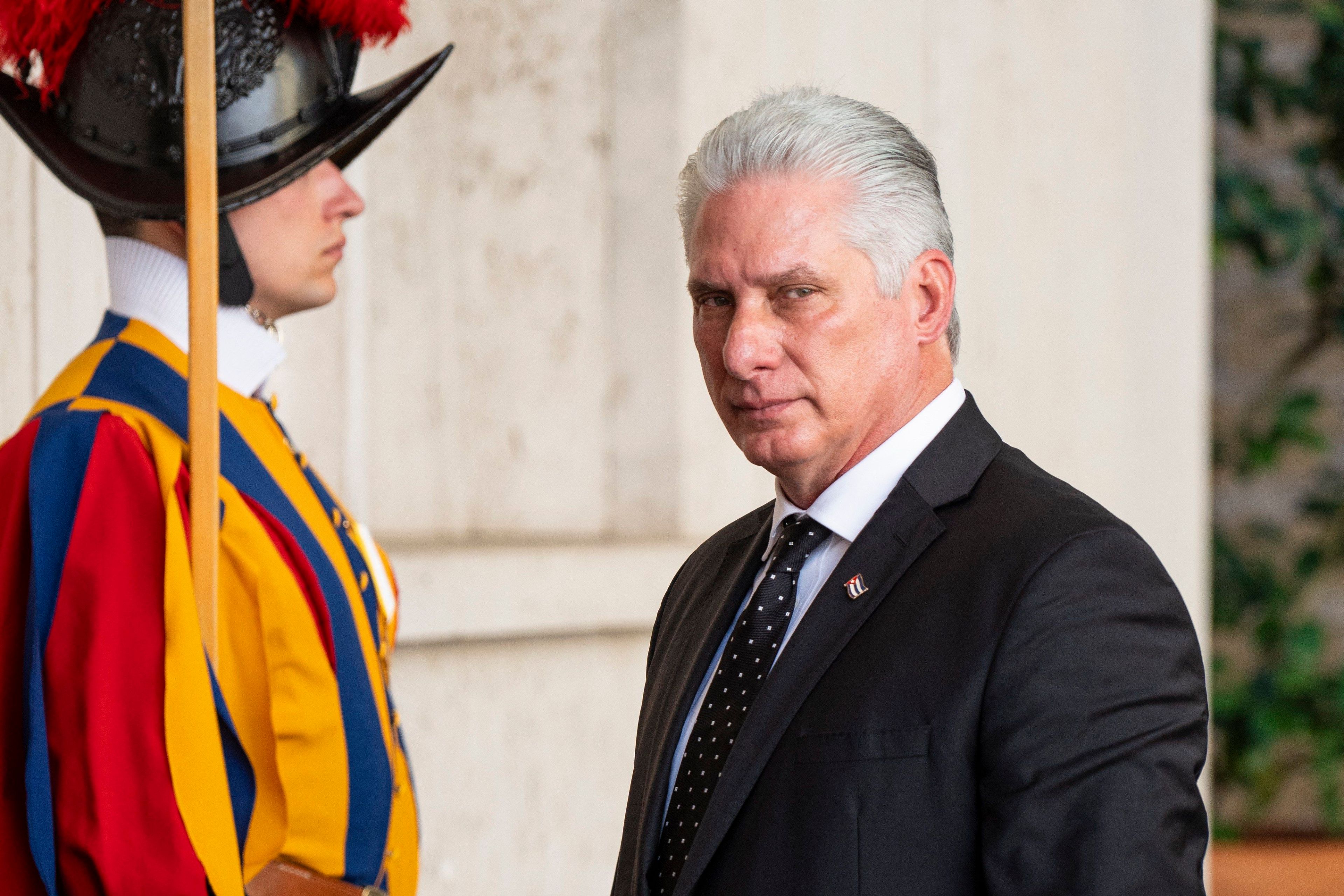
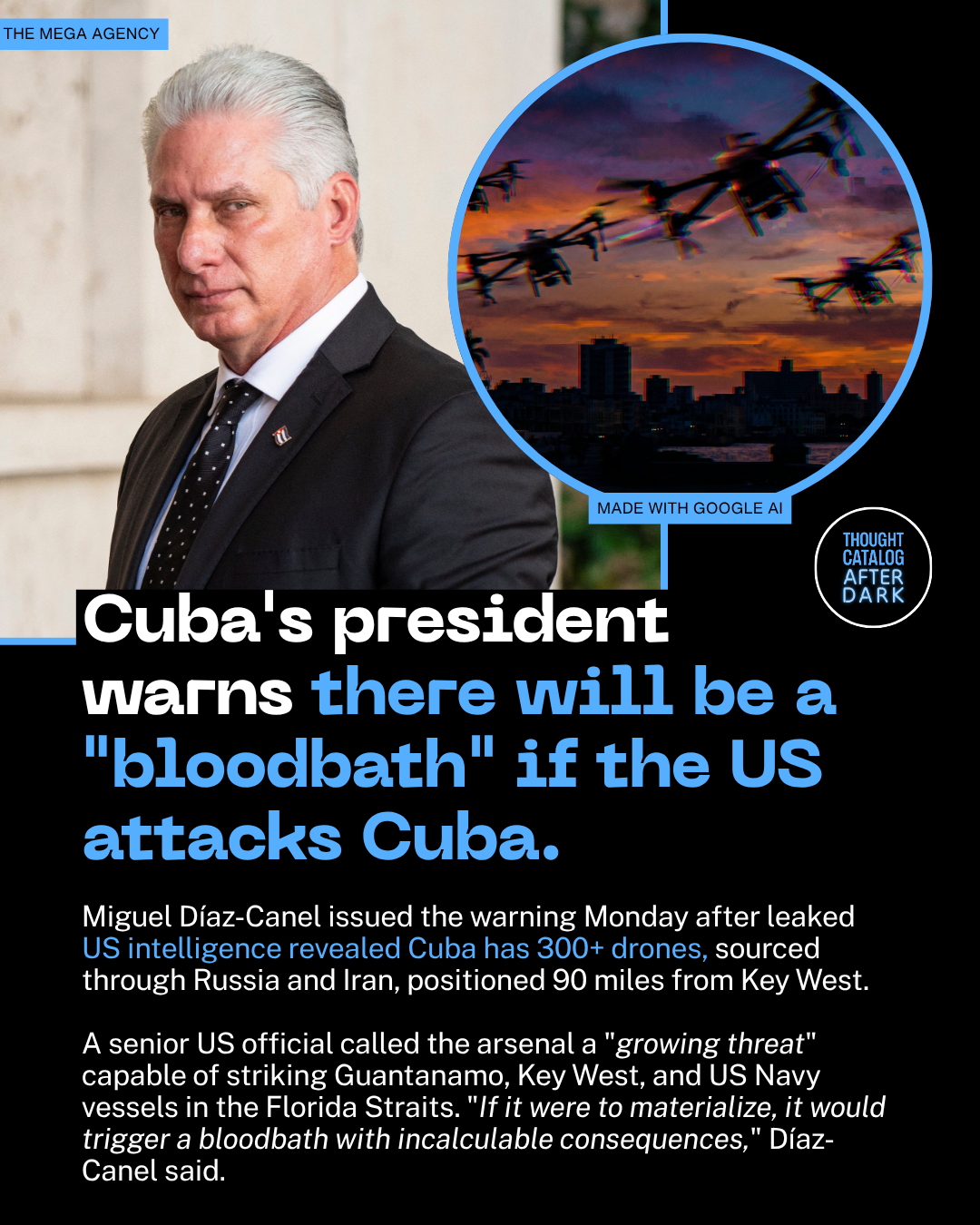
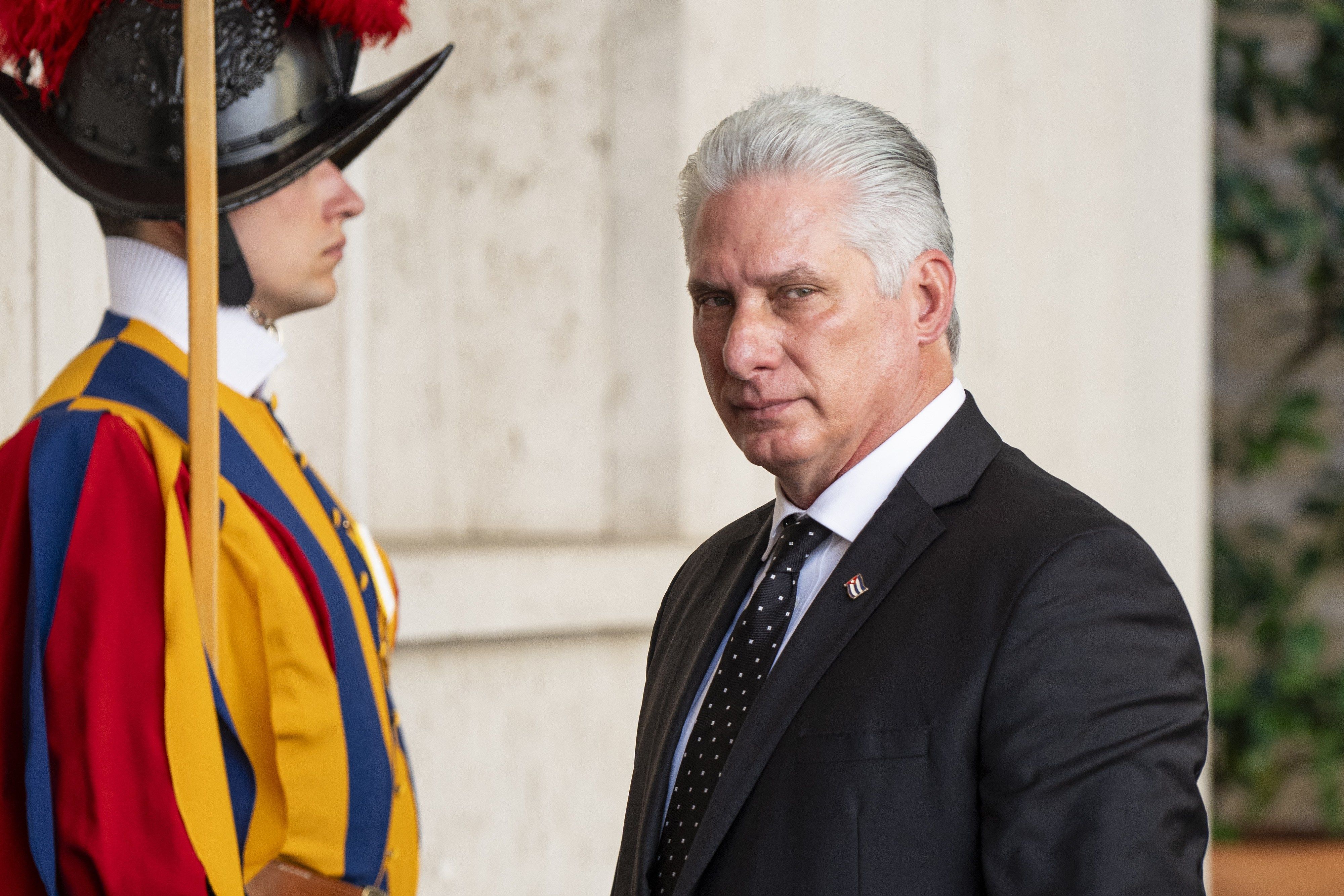
Cuba’s President Warns There Will Be a “Bloodbath” If the US Attacks Cuba.

Díaz-Canel posted the warning on X a day after Axios published classified intelligence showing Cuba’s drone buildup. He called the threat of US military aggression “an international crime” and said Cuba has the right to defend itself “against a military onslaught.”
The arsenal is more than 300 drones, including Shahed-136 loitering munitions and Mohajer-6 variants. The same hardware Iran sends Russia to hit Ukrainian cities. Cuba’s buildup began in 2023, sourced through Russia and Iran, with Iranian military advisers stationed in Havana to oversee the program. Russian and Chinese signals-intelligence facilities have been operating on the island for years.
What changed the US threat assessment is who is flying them. US intelligence estimates roughly 5,000 Cuban troops were sent to fight alongside Russian forces in Ukraine. Many returned home with practical drone-warfare experience against a NATO-equipped adversary.
Cuba’s defense doctrine is called “War of All the People.” It emphasizes asymmetric warfare and making any invasion prohibitively costly. The 300+ drones fit that posture cleanly. Most analysts read the arsenal as deterrent and propaganda rather than a credible first-strike capability, but the proximity to Florida (Key West sits roughly 90 miles from the Cuban coast) and the Iran-Russia supply chain elevated the intelligence community’s read.
Cuban Foreign Minister Bruno Rodríguez called the drone story a “fraudulent case” fabricated to justify sanctions or intervention, insisting the arsenal is purely defensive.
The timing is not random. On January 3, 2026, US special forces conducted an operation against Nicolás Maduro in Venezuela. Cuban troops were among those defending him and reportedly died in the action. Within months, Cuba lost the Venezuelan oil shipments that had kept its grid running. On May 14, Cuba’s Energy Minister Vicente de la O Levy announced the country had “absolutely no reserves” of oil or diesel. Hospitals and schools began closing. Daily blackouts stretched to 22 hours.
The same week, CIA Director John Ratcliffe flew to Havana. It was one of the rarest high-level US intelligence visits to the island since 1959. He delivered a message from President Trump: serious engagement on economic and security issues only if Cuba makes “fundamental changes.” The window, he said, is narrowing. Cuba’s Chargé d’Affaires Lianys Torres Rivera told The Hill that Cuba will hold its “red lines” and is “preparing” if a military attack occurs.
Two days after Ratcliffe’s visit, Axios published the classified intelligence on the 300+ drones. The next day, Díaz-Canel posted his bloodbath warning.
Treasury followed on May 18 and 19 with sanctions on Cuba’s Directorate of Intelligence, the Interior Ministry, and 11 senior officials, including the communications, energy, and justice ministers and several military leaders. The action builds on a May 1 executive order targeting repression and threats to US security.
Politico has since reported that US Southern Command is drafting contingency plans for action against Cuba, ranging from limited airstrikes to broader scenarios, after the oil blockade and sanctions failed to force changes. Officials told the outlet Cuba proved tougher than expected. No decision has been made.
A separate track is moving in parallel. The Trump administration is preparing an indictment of former Cuban President Raúl Castro, 94, for the 1996 shootdown of two unarmed Cessnas operated by Brothers to the Rescue, a Miami-based exile group founded by José Basulto. Four pilots were killed: Armando Alejandre Jr., Carlos Alberto Costa, Mario de la Peña, and Pablo Morales. Castro was Defense Minister at the time and reportedly gave the order. He is in Cuba, so the indictment is symbolic. The timing, ahead of any potential military action, is not.
The Trump administration has discussed military options against Cuba, usually listed third after Venezuela and Iran.