Sam Levinson Put His Foreshadowing For Rue’s Death Inside Euphoria S3E6. Here’s the Receipt.


In Episode 6 of Euphoria Season 3, Rue Bennett walks into a church, reads the Ten Commandments, and takes a call from her mother. She tells Leslie she just wants to be forgiven. The scene plays as a peace beat after a season of escalating violence and addiction.
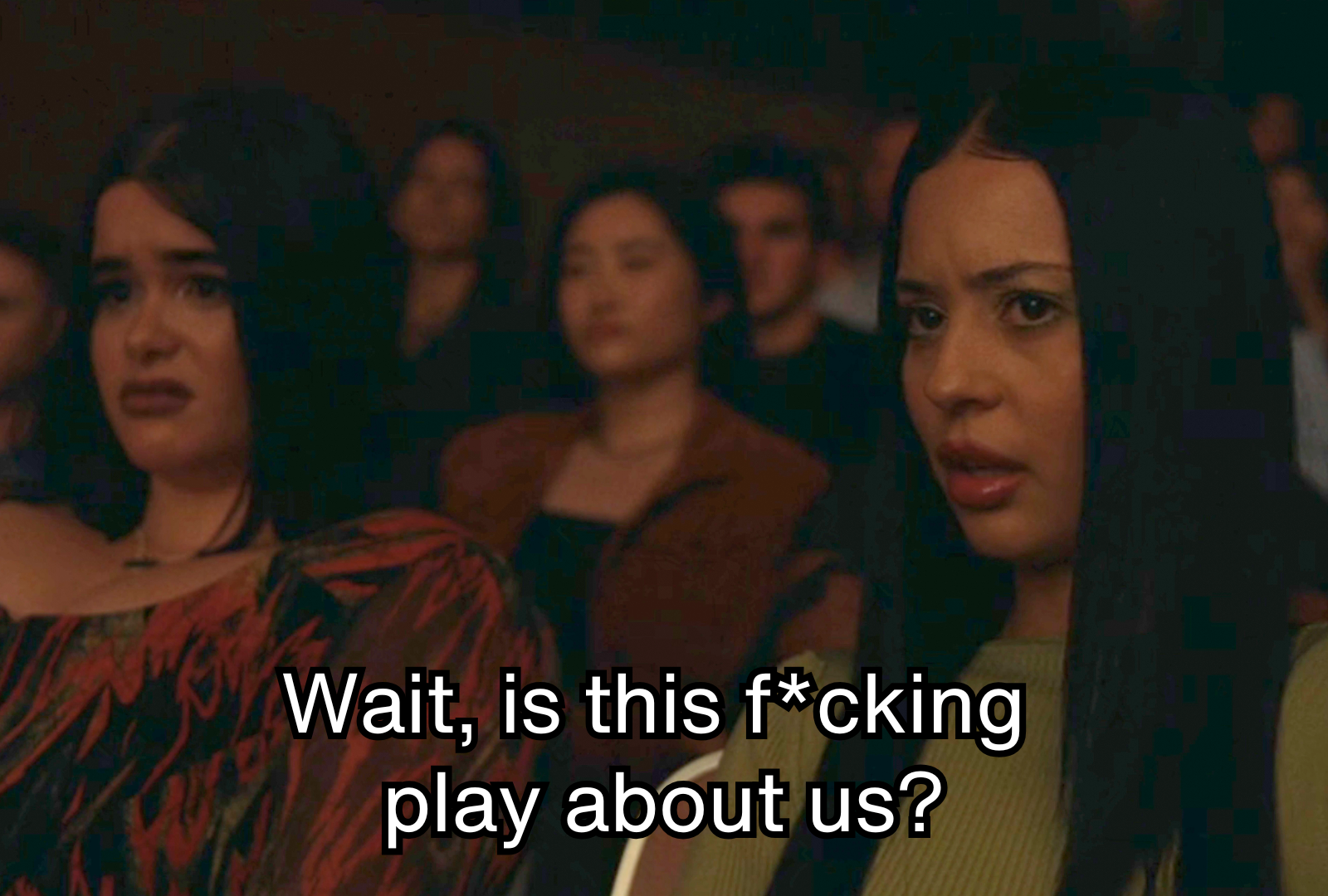
The next scene cuts to Lexi Howard’s poolside courtyard. Lexi and Gillie are debating her newest writing assignment.
Gillie: “Why don’t you just kill her character?”
Lexi: “Cause I’m supposed to build her up.”
Gillie: “So, build her up to kill her. If someone doesn’t die periodically, people get bored.”
That cut was deliberate. Levinson placed it where he did for a reason. After a season that’s tried to kill Rue in endless ways, the meta-foreshadowing is now sitting on screen for anyone paying attention.
The Near-Death Catalog: Season 3
Rue has been within reach of death in nearly every episode this season. The threats have escalated in cinematic creativity, which is the writers’ room signal that an arc is building toward an actual reckoning.
Episode 1. Rue is revealed as Laurie’s #1 fentanyl mule. She’s done 12 cross-border runs swallowing balloons. Body packing kills people regularly. A burst balloon is a fatal overdose.
Episode 2. Rue helps Alamo cover up Tish’s fentanyl-laced ecstasy overdose. She relapses. She’s been actively using opioids since.
Episode 4. Rue flips and becomes a federal confidential informant. The DEA explains the math: 20 years in federal prison with no parole, plus an additional 20 years for every death the agency can link to her supply chain. By the end of the episode, Magick has tipped off Alamo’s crew that Rue might be a snitch, right before Rue survives an armed robbery.
Episode 5. Alamo’s crew buries Rue alive up to her neck. A horse barrels toward her with a polo mallet swinging. She survives in the next episode.
Episode 6. Bishop tells Rue that he knows Leslie’s last name. The threat is now on her mother. She almost collides with a semi-truck while trying to troubleshoot her Bible audiobook.
That’s 5 distinct execution scenarios so far this season. The polo mallet sequence in particular is the kind of scene a show stages when it wants the audience to feel that survival is no longer plausible.
The Trope Has a Name: Build Her Up to Kill Her

The line Lexi delivers is a real piece of writers’ room language. Television showrunners have written publicly about the “build then break” structure for decades. Vince Gilligan used it on Breaking Bad. David Chase used it on The Sopranos. David Simon used it on The Wire. The principle is the same. An audience needs to be invested in a character before that character’s death can deliver a structural payoff.
The trope is so well documented that television writing programs teach it. The character given a hopeful arc, a redemption moment, or a future-tense voiceover is the character a showrunner is setting up to lose.
Rue spent S3E6 doing all 3.
She cried and prayed in church. She told Jules she wanted to start a life, get married, have a family. She called Leslie and said she was coming home. The hopeful voiceover, the redemption beat, the future-tense pitch. Levinson hit every prerequisite the structure requires.
The Lexi Cut Is the Showrunner Pointing at His Own Hand
Levinson is the sole credited writer on Euphoria. He’s been transparent in interviews that he doesn’t run a traditional writers’ room. Every word on screen is a word he placed there.
The decision to cut from Rue’s redemption beat directly to a writers’ room conversation about killing a character was a choice. He could’ve placed that conversation anywhere in the episode. He put it directly after the church.
In literary terms this is what’s called a structural rhyme. The technique is older than television. Hamlet uses a play-within-a-play to telegraph the truth about Claudius. Charlie Kaufman uses screenwriter characters in Adaptation. Levinson is using Lexi the same way: as a confession the audience is meant to catch. He’s beating the “is this f*cking play about us” horse over the head. Again.
The Counter-Argument
The strongest case for Rue’s survival is industrial. Zendaya is the lead, an executive producer, and a 2-time Emmy winner for the role. Killing the narrator of a series is rare. Killing the studio’s flagship performer mid-arc is rarer.
There’s also the simple structural problem. Rue narrates the show. Her voiceover is the spine of every episode.
The voiceover argument has a counter of its own. Television has a long tradition of narrators speaking from after their own deaths. Sunset Boulevard opens with William Holden’s body in a pool. American Beauty opens with Lester Burnham telling you he has 1 year to live. The Lovely Bones is narrated from heaven. Desperate Housewives is narrated by Mary Alice after her suicide.
A narrator who’s already dead is a structural feature. The form has been doing this for decades.
What’s Actually Different After S3E6
For most of Season 3, the “Rue dies” theory was a Reddit conversation. Polymarket had her at around 61% to survive. The fan consensus held that the show wouldn’t kill its protagonist mid-season.
S3E6 changed the math. The polo mallet scene in E5 raised the question. The Lexi cut in E6 answered it on screen.
Three episodes remain. The cut left Rue alive on screen, but it confirmed that Levinson knows the question every viewer is asking, and that he’s willing to sit at his desk and write the show’s own foreshadowing into the script.
The build is happening. The redemption beat has been placed. The mother’s last name is now a known target. The narrator just told her mom she’s coming home.
If someone doesn’t die periodically, people get bored.