The Pull of ’90s Parenting Comes Down to This: “Magic” They Think Their Kids Can’t Get Anymore
By Sari Moon
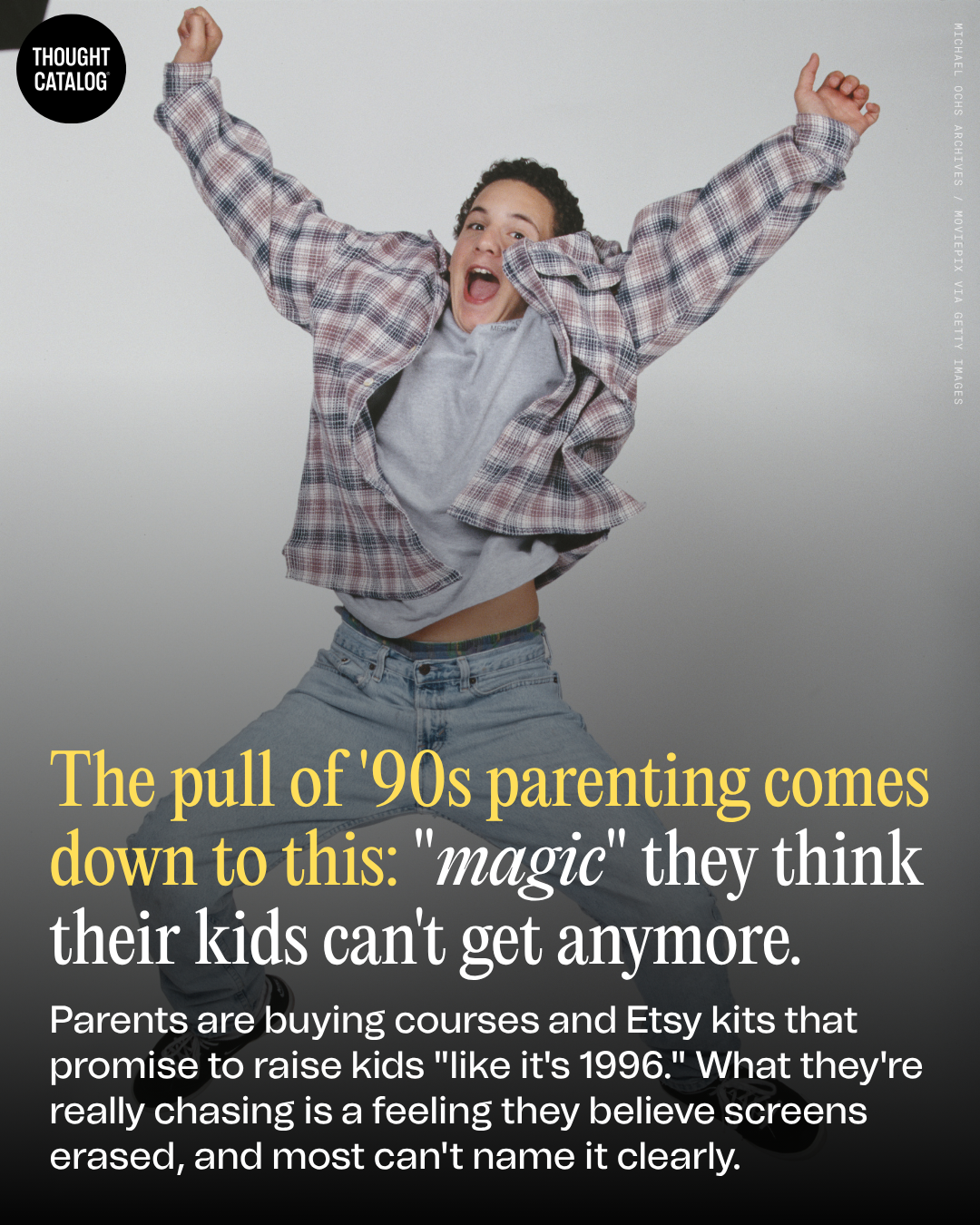
Parents are buying courses and Etsy kits that promise to raise kids “like it’s 1996.” What they’re really chasing is a feeling they believe screens erased, and most can’t name it clearly.
The mothers in one “’90s parenting” group meet on Zoom, a platform launched in 2012, at 9 p.m. to discuss raising children the way parents supposedly did three decades ago. Several weren’t even old enough to drive in the 1990s. One grew up on Hannah Montana, which premiered in 2006. Another had a Grimes poster. No father has ever asked to join.
In practice, “’90s parenting” means:
No screens at dinner
Independent, unstructured play, framed as the foundation of creativity, problem-solving and resilience
Chores, errands and manageable risks
Friendship-bracelet kits, decade-scented candles and retro logos
The nostalgia also has a storefront. One popular account, with nearly 650,000 Instagram followers, sells a quiet-time guide for $27 and a “Childhood Unplugged” course for $97. Its posts include declarations like, “Hills I will die on as a mom who’s locked in on raising her kids like it’s 1996.”

Yet when the mothers describe what they actually want, their language remains vague. One wanted her children to have “more room to grow and be themselves.” Another worried that the world had become so frightening that limiting screens might keep kids from getting “hooked like junkies.”
“That’s what we’re about, trying to recapture that magic,” said the group’s founder, Kayla, a lawyer and Etsy seller. “Kids should be able to watch a movie like Mrs. Doubtfire and enjoy it without having technology ruin it for them.” She ended the call by pitching bracelet kits beneath a Snapple-style “1990s Mom” logo.
The impulse behind the trend is real. American tweens average roughly 5.5 hours of entertainment screen time a day, while teens average more than 8.5, according to Common Sense Media.
Experts also support many of the ideas being repackaged as ’90s parenting. Developmental psychologist Peter Gray argues that independent play teaches children to solve their own problems, manage their activities and discover what they love. Depriving them of it, he says, can weaken resilience and increase anxiety.
Lenore Skenazy, founder of Free-Range Kids and Let Grow, similarly argues that constant adult supervision teaches children the world is too dangerous for them to navigate. Small, independent experiences can help reverse that message. Pediatrician Whitney Casares has pointed to the same anxiety driving the trend: parents fear that constant stimulation and tightly structured schedules are eroding their children’s grit and resilience.

But nostalgia cuts both ways. Harriet Walker of The Times called ’90s-parenting nostalgia a potential trap in which parents project their own discomfort with the present onto their children. A New York Times piece about Gen X raised the obvious question: if free-range childhoods were so superior, why did so many latchkey kids grow up to become helicopter parents?
Jason Diamond, who spent ages 9 through 19 in the 1990s, reached a similar conclusion after sitting through the Zoom call. When adults declare that the world has lost its magic, they are often describing their own sense of flatness, not their children’s. The capacity for wonder is still there. It just requires a parent willing to meet a child on their level instead of buying a $97 course that packages wonder as 1996.
Thank you for reading Thought Catalog. You can follow us on Facebook here. Or check out our website.