
Rue Proposed Marriage To Jules In This Week’s Euphoria Episode. Jules Slapped Her. It Was Their Opposite Defense Mechanisms Clashing.

Euphoria’s main timeline takes place in 2026, 5 years after the show’s original high-school cast graduated. The major characters are in their early 20s. The relationships from high school are mostly still in some version of motion.
Rue Bennett is 22 in Season 3. She’s an opioid addict, a federal informant, and currently working as bouncer-manager at a strip club owned by a man named Alamo Brown. His righthand man Bishop just told her that he knows her mother’s last name. He buried her up to her neck in a field one episode earlier.
Jules Vaughn has been the love of Rue’s life since Seasons 1 and 2. By Season 3 she’s a sugar baby for a married plastic surgeon named Ellis. Ellis pays for her apartment, her studio, and her art supplies. His wife knows about Jules. Jules knows about his wife.
Rue walks into Jules’s apartment unannounced. The scene runs about 6 minutes. By the end of it, Rue has proposed marriage and Jules has slapped her. Both moves are their respective defense mechanisms at play, and they react like oil and water.
What Rue is doing has a clinical name. Magical thinking. The mechanism: when present reality is unbearable, the mind builds a future life event and uses the imagined future as a substitute for solving the current problem.
The fantasy carries the emotional weight. The present carries none.
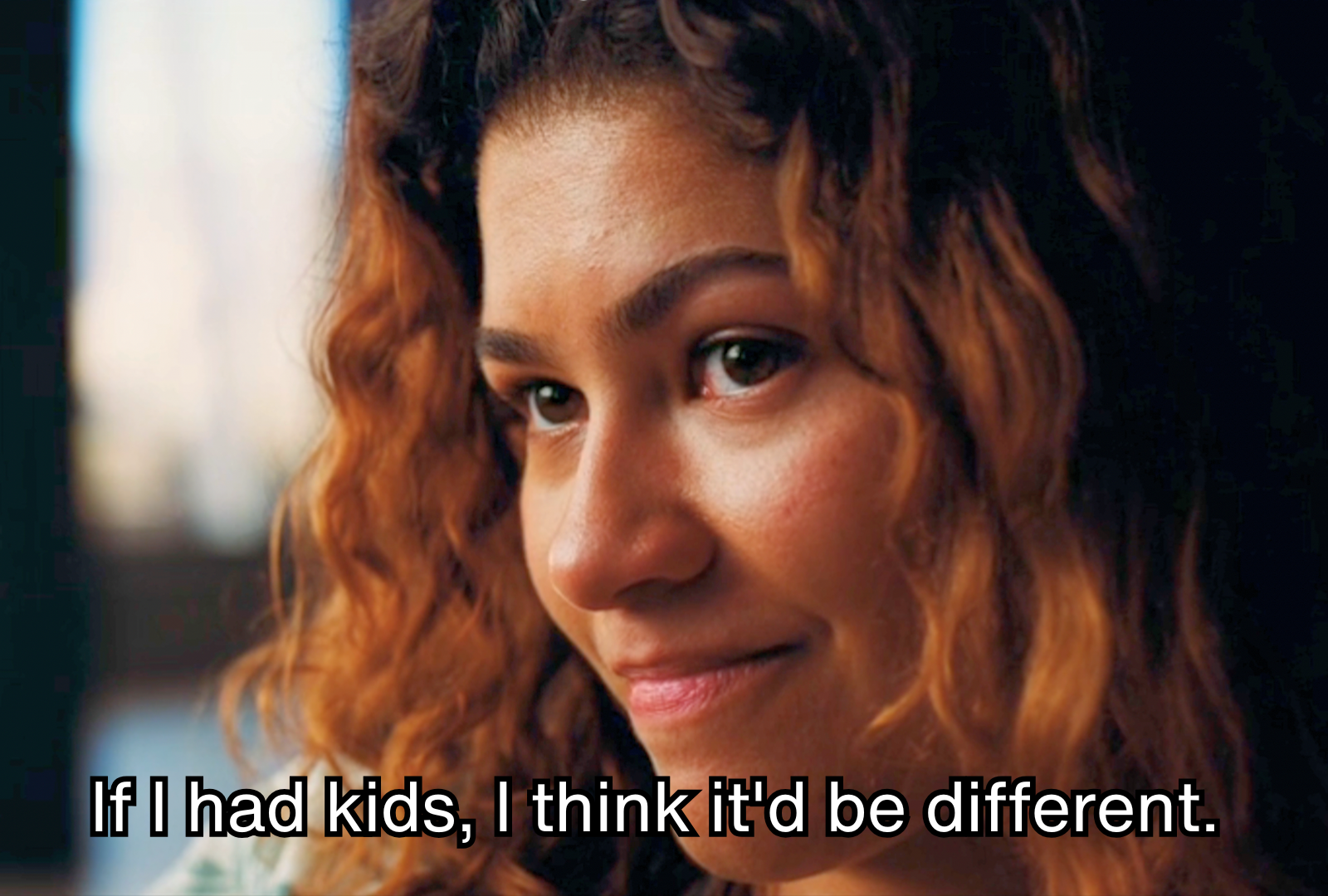
The specific variation Rue runs is the kid-as-solution. “If I had kids, I think it’d be different.” “I have to live for something greater than myself.” The proposal is dressed up in recovery vocabulary. The script underneath is older than recovery. It says a child, or a marriage, or a normal life will retroactively justify everything Rue has done and reset who she gets to be next.
Daniel Gilbert at Harvard has spent decades documenting how badly humans predict what will make them happy. Sonja Lyubomirsky’s “The Myths of Happiness” runs the same research against the specific life events Americans bet on: marriage, kids, money, a move. The events deliver less happiness than people expect.
Rue’s “I’m not really counting the days this time” line when Jules asks about her sobriety is the structural tell. Counting days is the first task of early recovery. Refusing to count usually means the sobriety doesn’t have structure, or the day count is too small to say out loud, or both.
What Jules is doing has a different clinical name. Differentiation of self. The term comes from Murray Bowen, the psychiatrist who founded family systems theory at the National Institute of Mental Health in the 1960s.
Differentiation of self is the capacity to see your circumstances clearly, accept the terms you’ve agreed to, and pursue your own work inside them without confusing the situation for something it isn’t. Bowen developed a scale for it. Highly differentiated people can hold opposing facts about their own lives in mind without collapsing.
They can name the limits of a relationship while staying in it. They can take help from someone without rebranding the help as love. They can recognize their own defenses without performing them.
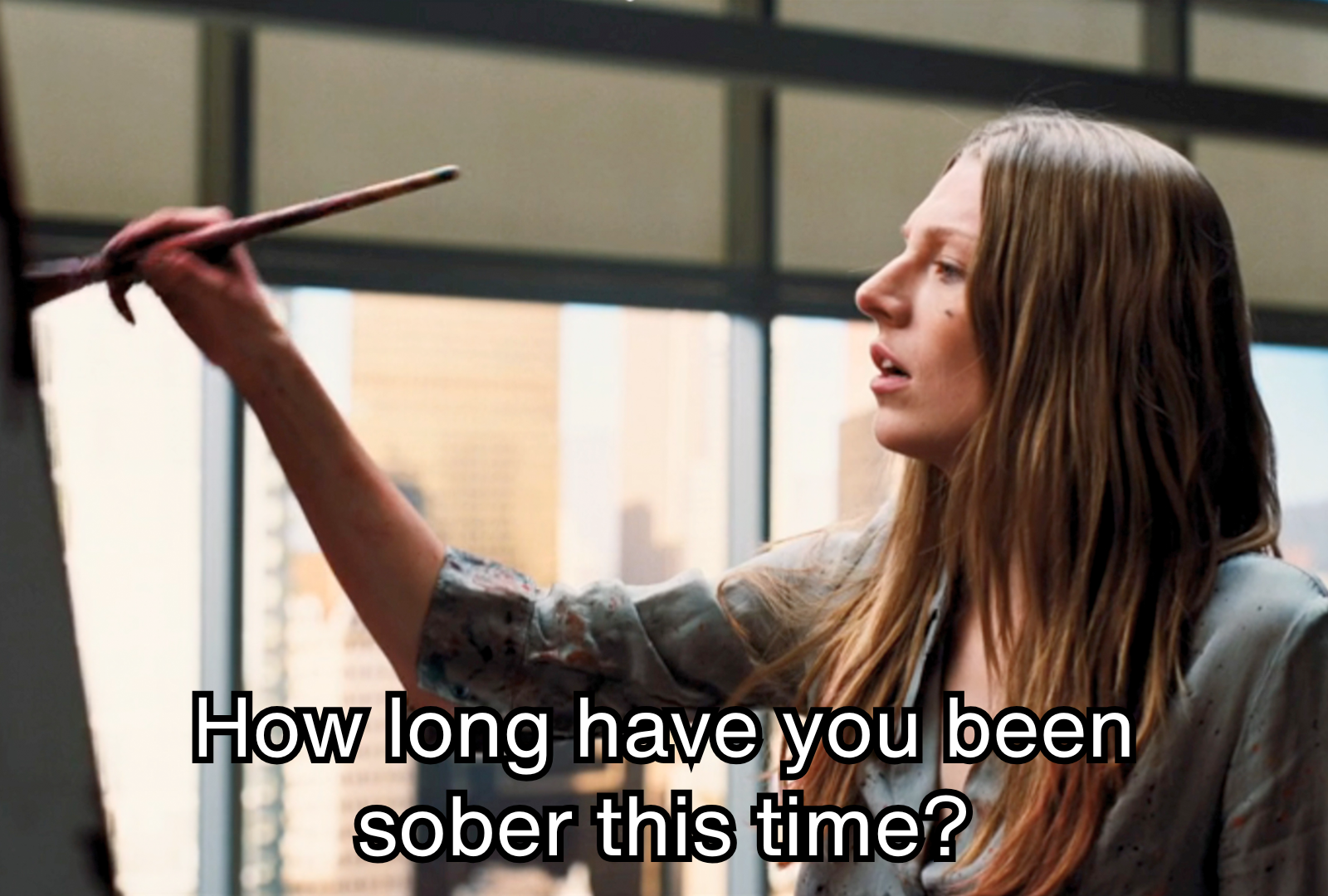
Jules is on the upper end of the scale in this scene. Ellis is married. The arrangement is paying her rent. His wife knows about her. The studio is a real studio. The painting on the easel is real work.
All of those facts are true at the same time. Jules names every one of them without flinching.
She also reads Rue immediately. “What you’re doing is kind of a fantasy.” “You show up, you disappear, you make plans, you don’t follow through, and now you’re here like professing your love.” “Where’s our relationship? In your head?”
These are the questions of someone who has had this conversation enough times to know how it ends.
The reason the conversation cannot survive is that Rue is using the word “love” to mean the feeling that should be enough to start over. Jules is using the word “love” to mean a track record. Rue keeps showing up without a track record. Jules has built one with someone else.
Every offer Rue makes depends on Jules tearing down what’s keeping her alive. The studio is funded by the arrangement Rue is asking Jules to leave. The future Rue is proposing has none of those structures attached.
She has no job, no housing, no sobriety she can prove, and an open federal case. The most she can offer Jules is the idea of a different life.
When Jules names the pattern, Rue can’t sit with it. She switches moves. The woman she was just proposing to becomes “a little toy that he keeps locked in a little room. Don’t go anywhere, don’t see anyone. Just stay there and paint until I come back to f*ck you.”
The clinical name for that switch is splitting. Common in active addiction and in borderline traits. Idealization to devaluation in under a minute.
The person who was the solution becomes the worst possible version of herself the moment she fails to play her role. Rue is doing what addicts do under pressure. She’s projecting her own emptiness onto the most stable thing in the room and trying to break it so it’ll match.
Jules slaps her. Then she names Ellis. “Ellis is gonna be here in 45 minutes, so I suggest you get the f*ck out of my painting.”
The slap is a boundary. It is the moment Jules stops trying to talk Rue out of the fantasy and starts protecting what she’s built.
The fact that she names Ellis in the same breath is deliberate. The man paying for the apartment is on the way. The painting on the easel is made possible through his patronage.
Rue is not part of the life Jules has chosen, and the life Jules has chosen has a schedule that doesn’t pause for Rue’s vision.
By the end of the scene, Rue has been told who she is by someone who actually knows her. The fantasy isn’t going to land. Jules isn’t going to follow her into it.
What Rue does next is go to a church. Then she calls her mother. She tells Leslie she wants to be forgiven. The next defense in the queue.
Magical thinking has a long tail. The first version collapses and the mind reaches for the next one.
The structure of Rue’s character in Season 3 is that she keeps reaching. The structure of Jules’s character is that she stopped.